
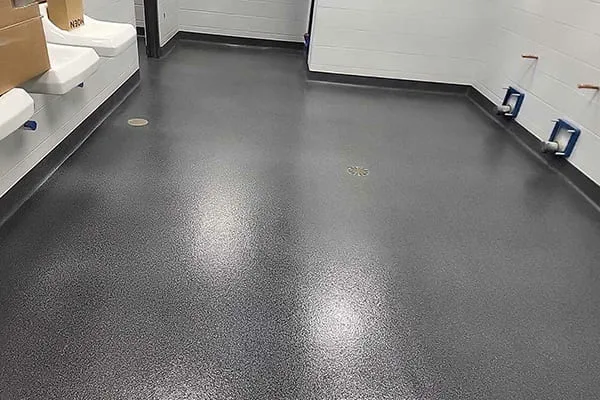
In the flooring industry, the difference between a “good” job and a “premium” job is measured in millimeters. Whether you are prepping a warehouse for epoxy coating or laying the foundation for a luxury showroom, your subfloor must be dead-flat.
For years, contractors relied on the “barrel and drill” method. But as project scales grow and tolerances tighten, manual mixing is becoming a liability. Here is why the industry is pivoting toward PLC-controlled self-leveling equipment.
1. Eliminating the “Human Variable” in Hydration
Self-leveling compounds are high-performance chemical blends. They are notorious for being water-sensitive. Add a cup too much water, and you get bleeding and chalking (that white, dusty film on top). Add too little, and the material won’t flow, leaving you with ugly ridges and trowel marks.
Modern Self-Leveling Equipment takes the guesswork out of the equation. By using automated water dosing and high-shear continuous mixing, the machine ensures that the first batch is chemically identical to the last. This consistency is what prevents cracking and ensures the polymer bond reaches its full strength.
2. Managing the “Wet Edge” at Scale
The biggest enemy of a smooth floor is time. Self-leveling materials have a very short pot life. If you are mixing in batches, the first area you poured is already starting to “skin over” by the time you bring the next bucket. This creates visible seams or “cold joints.”
An automated mix-to-pump workflow allows for a continuous pour. By maintaining a constant flow of material, your crew can maintain a “wet edge” across thousands of square feet. Instead of racing against the clock with buckets, your team can focus on using a spiked roller or a smoother to perfect the finish.
3. The PLC Advantage: Speed Without Chaos
Look at any modern job site, and you’ll see that the bottleneck is usually the mixing station. A PLC-controlled mixer automates the labor-intensive part of the process. It doesn’t get tired, and it doesn’t lose count of how many bags went in.
For a contractor, this means you can pour a floor in one-third of the time it takes a manual crew. When you can finish a 500-square-meter floor before lunch, your overhead drops and your profit per square meter skyrockets.
4. Reducing Physical Burnout and Liability
Let’s be honest: lugging 25kg bags and hunching over a mixing barrel all day destroys a crew’s morale and their backs. Mechanical pumping moves the heavy lifting from the workers’ spines to the machine’s hydraulics. A fresher crew makes fewer mistakes, and fewer mistakes mean no expensive grinding or re-pouring.
The Verdict
The market is shifting. Clients are no longer accepting “close enough” when it comes to floor flatness. Investing in automated self-leveling equipment isn’t just about buying a machine; it’s about buying the ability to guarantee a mirror-smooth, professional finish on every single project, regardless of the square footage.