
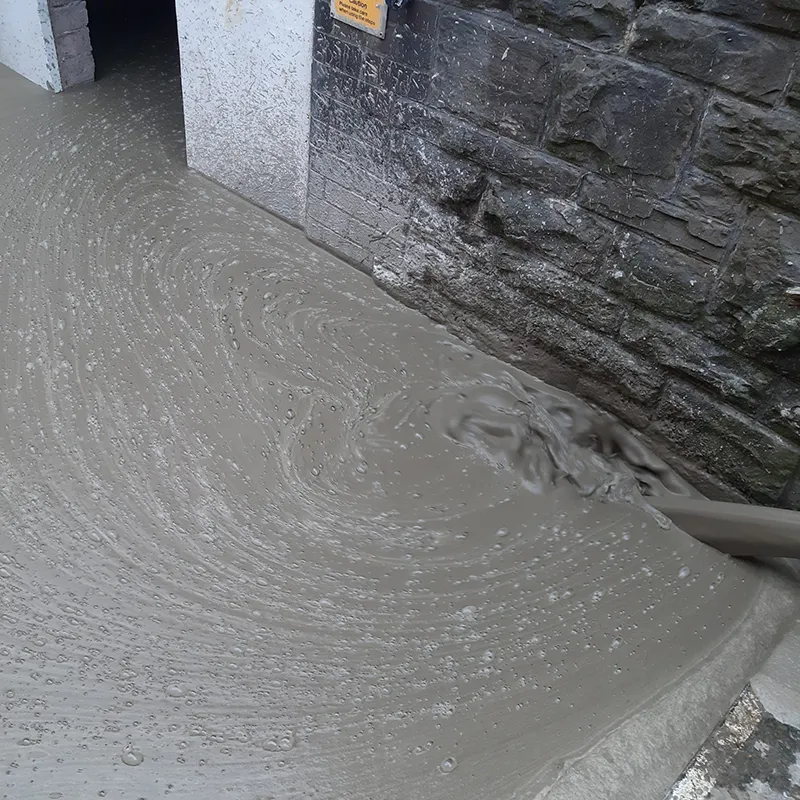
In the world of modern construction, weight is often the enemy. Whether you are leveling a floor in a high-rise or filling a decommissioned underground tank, every extra pound adds stress to the structure and the budget. This is why Foam Concrete (Cellular Lightweight Concrete) has moved from a niche specialty to a job-site staple.
But here is the reality: Foam concrete is a finicky beast. If you don’t respect the physics of the bubble, you end up with a brittle, sinking mess.
The Science of a Stable Mix
At its core, foam concrete is just a slurry of cement, water, and pre-formed foam. However, the “secret sauce” isn’t the ingredients—it’s the cell stability.
When we talk about high-quality foam concrete, we are looking for a closed-cell structure. Imagine millions of tiny, independent balloons trapped in a cement matrix. If those bubbles pop before the cement sets, the density spikes, and your insulation values vanish. To get this right, you need a foam generator that produces a stiff, shaving-cream-like consistency that can withstand the hydrostatic pressure of the wet cement.
Why “Guesswork” Kills Your Margin
The biggest mistake on most job sites is treating foam concrete like standard 3000-psi mix. It isn’t. Density control is the only metric that matters.
- For Roof Insulation: You’re likely aiming for a dry density of 400–600 kg/m³.
- For Floor Screeds: You might push that to 1200 kg/m³ for better compressive strength.
If your equipment can’t dial in the precise foam density on the fly, you are playing a guessing game with your materials. A slight drift in the air-to-liquid ratio can lead to “bleeding” or segregation, where the heavy cement sinks to the bottom and the foam floats to the top. The result? A floor that cracks the moment someone walks on it.
The Hardware Factor: Moving Beyond Manual
The old way of batching involved a lot of luck and a lot of manual labor. Modern projects don’t have time for that. This is where automated, high-output hydraulic setups change the game.
Using a dedicated Foam Concrete Machine handles the heavy lifting by:
- Uniform Mixing: Ensuring every cubic meter of slurry is identical to the last.
- Continuous Pumping: Keeping the flow steady to avoid cold joints.
- Real-time Calibration: Allowing operators to adjust the mix as environmental conditions (like heat or humidity) change.
Solving the “Cracking” Problem
One of the most common complaints about lightweight concrete is shrinkage cracking. Experienced contractors know that this usually boils down to two things: water-cement ratio and curing.
Because foam concrete uses a lot of air, it’s tempting to add too much water to make it pump easier. Don’t. Excess water creates capillary channels that weaken the final product. The goal is a “thixotropic” mix—one that flows under pressure but stays put once it hits the deck.
The Bottom Line
Foam concrete is a high-margin service if you can prove to your clients that you can hit their specs every single time. It’s about more than just filling space; it’s about controlling the air.
Whether you are tackling a massive CLSM (Controlled Low-Strength Material) backfill or a delicate residential floor leveling job, the equipment you choose is the difference between a smooth, mirror-finish handoff and a week of expensive rework.